Good Debt vs Bad Debt: The Smart Way to Borrow, Grow, and Become Debt-Free
Understanding the key differences between good debt and bad debt helps you borrow wisely, avoid high-interest traps, and use credit to build long-term wealth instead of financial stress.
📘 In This Guide 👇
- Good Debt vs Bad Debt: Key Differences Explained
- Why Debt Feels So Heavy
- What Is Good Debt? (The Wealth Builder)
- What Is Bad Debt? (The Wealth Killer)
- The Gray Area: Car Loans and Other “Necessary” Debt
- The Smart Borrowing Test
- If You Already Have Bad Debt — Here’s How to Escape It
- Good Debt vs Bad Debt — Quick Comparison
- Final Thoughts: Debt is not the enemy
Good Debt vs Bad Debt: Key Differences Explained
Debt is one of the most misunderstood forces in personal finance. Most people grow up hearing just one rule: “All debt is bad.” But that simple belief hides a far more important truth — and it’s the reason many people work hard their entire lives yet never get ahead.
The reality is this:
Some debt makes you wealthier.
Other debt keeps you trapped.
Also known as productive debt vs consumptive debt, understanding this difference helps you decide whether borrowing will increase your net worth or reduce it.
Debt itself is not the problem. How it is used is.
The same tool that allows businesses to grow, investors to multiply money, and entire economies to expand is the same tool that silently drains millions of families through high interest, poor decisions, and endless payments.
When used wisely, debt can accelerate your progress, open opportunities, and help you grow faster than savings ever could. When used wrongly, it traps you in stress and steals your future.
This guide will show you:
- The difference between good debt and bad debt
- How to use borrowing to grow instead of struggle
- And how to escape harmful debt once and for all
If you’re struggling with debt because your income feels tight, start with our how to create a monthly budget that works to regain control and proven strategies to save money fast even on a low income.
What Is the Difference Between Good Debt and Bad Debt?
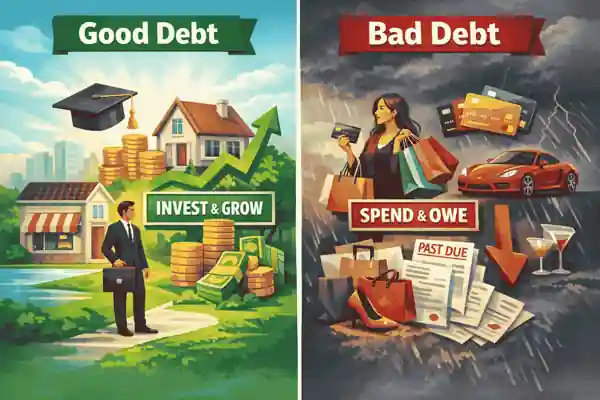
Good debt is borrowing used to increase income or build long-term wealth, such as student loans, business loans, or real estate.
Bad debt is borrowing used for consumption that loses value or creates financial strain, such as credit card debt, payday loans, or financing luxury purchases.
This guide is based on proven debt and borrowing systems used by financial counselors, nonprofit credit agencies, and long-term savers around the world.
Why Debt Feels So Heavy
Debt becomes dangerous when it stops working for you and starts working against you.
It reaches that point when most of your income is swallowed by interest, not by progress. Instead of your money building anything meaningful, it simply pays for the privilege of borrowing. You work harder, but your balance barely moves.
It becomes even more painful when you’re forced to borrow just to survive — to pay rent, cover food, or keep the lights on. At that stage, debt is no longer a tool. It is a lifeline. And lifeline debt keeps you stuck in a cycle where every month begins with stress and ends with another bill.
Worst of all, debt traps you when you can’t save, invest, or breathe financially because every dollar you earn is already promised to lenders.
This is exactly why creating a simple monthly budget that works is the first step to escaping debt.
You have no room to plan, no cushion for emergencies, and no ability to build wealth. You are constantly reacting instead of moving forward.
This is how millions of people become trapped — not because they borrowed, but because they borrowed for the wrong reasons and under the wrong conditions.
To take back control, you must first understand the two types of debt — the kind that quietly destroys your future, and the kind that can help you build it.
Types of Debt You Should Understand
- Secured Debt – Backed by collateral (mortgages, auto loans).
- Unsecured Debt – Not backed by assets (credit cards, personal loans).
- Revolving Debt – Ongoing credit you can reuse (credit cards).
- Installment Debt – Fixed payments over time (student loans).
Understanding these categories helps you identify risk levels and borrowing costs before signing any agreement.
What Is Good Debt? (The Wealth Builder)
Good debt is money borrowed to improve your financial future.
It is used for things that increase what you earn, help you own valuable assets, or create benefits that last for many years.
Instead of draining you, this type of debt adds to your net worth. When used wisely, it allows you to grow faster than you could on your own and makes you wealthier over time.
Examples of Good Debt
1. Education and Skill Training
Courses, certifications, or degrees that increase your income potential are investments. They raise your lifetime earning power.
2. Real Estate (Mortgages)
Instead of paying rent forever, a mortgage allows you to build ownership in an asset that typically rises in value.
3. Business Loans
Borrowing to start or grow a business can multiply your income if the profit is higher than the interest.
Good debt works for you even while you sleep.
If you’re looking for ideas to turn good debt into income, explore our make money guide for side hustles and online income ideas.
Example of Good Debt in Action
If you borrow $10,000 at 6% interest to start a small business and it generates $25,000 in profit within two years, the debt helped create income far greater than its cost.
What Is Bad Debt? (The Wealth Killer)
Bad debt is money borrowed for consumption rather than growth. It is used to buy things that quickly lose value, get used up, or do not produce any income in return.
Because this type of debt does not create anything that pays you back, it becomes a financial burden. Even worse, bad debt often carries high interest, which means you end up paying far more than what the item was actually worth.
Examples of Bad Debt
- Credit cards used for food, clothes, or entertainment
- Payday loans
- Financing phones, gadgets, or luxury items
- Borrowing to maintain a lifestyle you cannot afford
Bad debt gives you pleasure today — and problems tomorrow.
If credit cards and payday loans are hurting you, our Loans & Debt hub shows how to break free and rebuild your finances.
Example of Bad Debt in Action
Charging $5,000 on a credit card at 24% interest for non-essential purchases could cost over $1,000 in interest alone if not paid quickly.
Once you understand your loan structure, follow this step-by-step debt payoff system to eliminate balances faster.
The Gray Area: Car Loans and Other “Necessary” Debt
Some types of debt fall between good and bad. For example, a car loses value, but it may be necessary to get to work, run a business, or earn income.
The key rule is simple: borrow for function, not for status. If a purchase helps you earn, move, or operate efficiently, the debt may be reasonable. If it is only meant to impress, it becomes a financial burden.
A modest, reliable car that supports your work can make sense. An expensive luxury car bought on credit only adds pressure without improving your income.
The rule is simple:
Borrow for function, not for status.
A reliable $8,000 car that helps you earn is reasonable.
A $60,000 luxury car financed on debt is financial poison
Why High-Interest Debt Is Dangerous
High-interest debt compounds quickly. When interest rates exceed 20%, payments often cover interest before reducing principal. This slows progress and increases total repayment cost dramatically.
That is why financial experts recommend eliminating high-interest debt before investing.
The Smart Borrowing Test
Before taking any loan, pause and ask these three simple questions:
- Will this help me earn more money?
- Will it increase my long-term net worth?
- Will the benefit be greater than the interest I will pay?
If the answer is no, the loan is likely bad debt and will only weaken your finances instead of improving them.
The Emotional Trap of Debt
Debt decisions are rarely logical — they are emotional. Advertising, peer pressure, and lifestyle comparison push people to borrow for status instead of stability.
Recognizing emotional spending patterns is one of the most powerful financial skills you can develop.
If You Already Have Bad Debt — Here’s How to Escape It
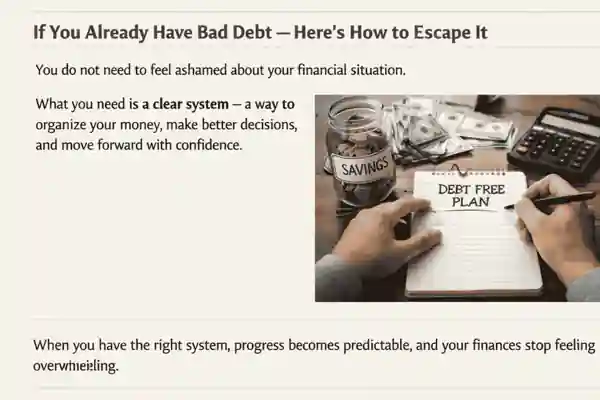
You do not need to feel ashamed about your financial situation.
What you need is a clear system — a way to organize your money, make better decisions, and move forward with confidence.
When you have the right system, progress becomes predictable, and your finances stop feeling overwhelming.
Step 1: List Everything You Owe
Write down every debt you have, including:
- The balance
- The interest rate
- And the minimum payment.
Seeing everything in one place gives you clarity and control.
You cannot solve a problem you refuse to face — and this step is how you take back control.
Step 2: Choose a Payoff Strategy
You can use any of the following strategies to pay off your debt:
1. The snowball method
Where you pay off your smallest debts first to build motivation.
2. The avalanche method
Where you focus on the highest-interest debts first to save the most money.
Both approaches work — the best one is the one you can follow consistently. You’ll need a sustainable repayment budget to stay consistent.
Step 3: Free Up More Money
Cut:
- Subscriptions
- Eating out
- Impulse spending
Every dollar saved is a dollar that attacks your debt. Freeing up extra cash through intentional saving strategies can strengthen your repayment plan.
Step 4: Increase Your Income
Debt becomes easier to eliminate when your income grows. Even a small increase in what you earn can make a big difference over time.
Side hustles, freelancing, or online work can provide extra cash — see our Make Money section for proven ways to boost your income.
Step 5: Stop New Borrowing
A debt plan only works if you stop adding new debt. No matter how good your strategy is, it will fail if you keep using credit to spend.
Freeze your cards and rely on cash or debit instead. This forces you to live within what you earn and allows your balance to finally move in the right direction.
Step 6: Build a Mini Emergency Fund
Set aside a small emergency fund, even if it’s just $300–$500. This gives you a cushion for unexpected expenses so you don’t have to rely on credit again.
It’s one of the most important steps for staying debt-free after you’ve worked so hard to get out.
Good Debt vs Bad Debt — Quick Comparison
| Feature | Good Debt | Bad Debt |
|---|---|---|
| Purpose | Builds your future | Buys the present |
| Value | Grows or earns money | Loses value over time |
| Interest | Usually low | Usually high |
| Effect | Increases wealth | Destroys wealth |
Learn More on SmartMoneyTrek
Explore our core financial guides:
- Save Money – proven ways to cut bills and build savings
- Budgeting – Tools and strategies to control your money
- Make Money – real side hustles and income ideas
- Loans & Debt – How to borrow wisely and eliminate debt
Why This Advice Works
This guide follows principles used by certified financial planners, nonprofit credit counseling agencies, and long-term wealth builders.
The distinction between productive (income-generating) debt and consumptive (depreciating) debt is widely recognized in personal finance education and wealth-building frameworks.
Final Thoughts: Debt Is Not the Enemy
Mastering the difference between good debt and bad debt is one of the most important financial skills you will ever develop.
Use debt strategically to accelerate opportunity.
Eliminate high-interest liabilities aggressively.
Build assets consistently.
That is how wealth is built — not by avoiding debt entirely, but by controlling it.
This content is for educational purposes only and does not constitute financial advice.