
Best Budgeting Method for Beginners: Why the 50/30/20 Rule Wins
📘 In This Guide 👇
- Introduction to Best Budgeting Concepts
- What Makes a Budgeting Method Ideal for Beginners?
- The Structure of the 50/30/20 Rule
- Why the 50/30/20 Rule Wins for Beginners
- How It Compares to Other Budgeting Methods
- What If You Can’t Reach 20% Savings Yet?
- A Simple Example
- Who Might Need a Different System?
- Why This Method Builds Long-Term Financial Discipline
- Is the 50/30/20 Rule the Best Budgeting Method for You?
- Frequently Asked Questions
- Final Thoughts: When money is limited, building extra income is essential
Introduction to Best Budgeting Concepts
Choosing the best budgeting method for beginners can feel overwhelming at first. It's like standing in front of a control panel full of buttons you don’t understand. There are spreadsheets, apps, envelope systems, zero-based methods — and every expert seems to swear theirs is the “right” one.
It’s no surprise many beginners quit before they truly begin.
The real problem isn’t laziness or lack of discipline. It’s complexity. Most people choose budgeting systems that demand precision before they’ve built consistency.
If you’re just starting out, you don’t need a complicated financial blueprint.
You need something simple, flexible, and sustainable.
That’s where the 50/30/20 rule stands out — not as a trendy tip, but as a practical framework that works in real life.
If you're looking for a full budgeting system beyond percentage-based planning, read our complete monthly budgeting guide.
This guide is based on proven budgeting systems used by financial counselors, nonprofit credit agencies, and long-term savers around the world.
At SmartMoneyTrek, we focus on practical personal finance systems designed for real people — especially those building stability from limited income.
What Makes a Budgeting Method Ideal for Beginners?
Before calling any budgeting system “the best,” it’s important to first understand what beginners truly need.
A great starter budgeting method should be simple enough to grasp in minutes, without requiring complex calculations or financial jargon. It shouldn’t demand excessive tracking that quickly becomes overwhelming. Instead, it should offer flexibility — allowing you to adjust when your income changes or unexpected expenses arise.
Most importantly, a beginner-friendly budget should naturally build saving habits into your routine and feel realistic to maintain. If a system feels too strict or complicated, people abandon it — not because they lack discipline, but because the method isn’t sustainable.
Many budgeting strategies fall short in one or more of these areas.
The 50/30/20 rule doesn’t.
Saving money works best when you are tracking every dollar with a monthly budget.
The Structure of the 50/30/20 Rule
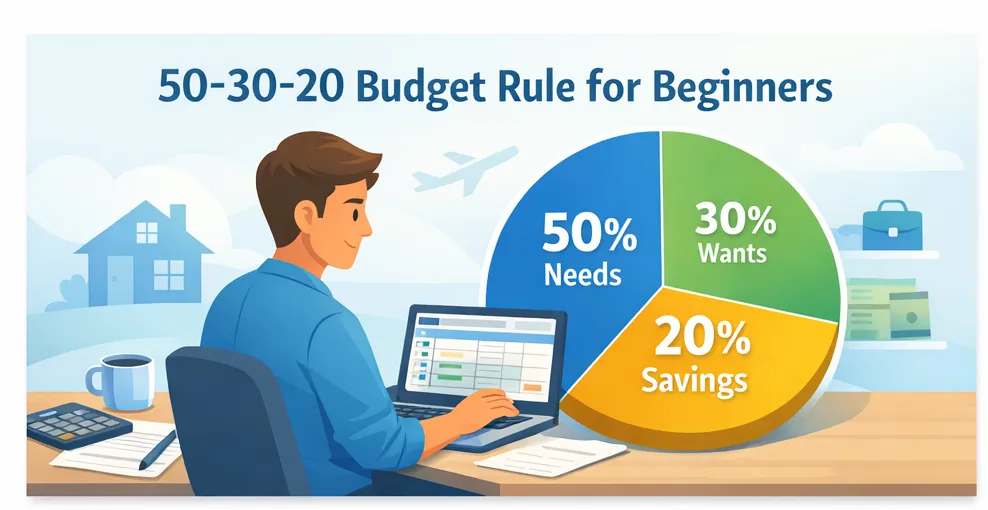
The 50/30/20 rule was popularized by Harvard bankruptcy expert Elizabeth Warren in her book All Your Worth: The Ultimate Lifetime Money Plan, where she introduced this balanced percentage-based budgeting system.
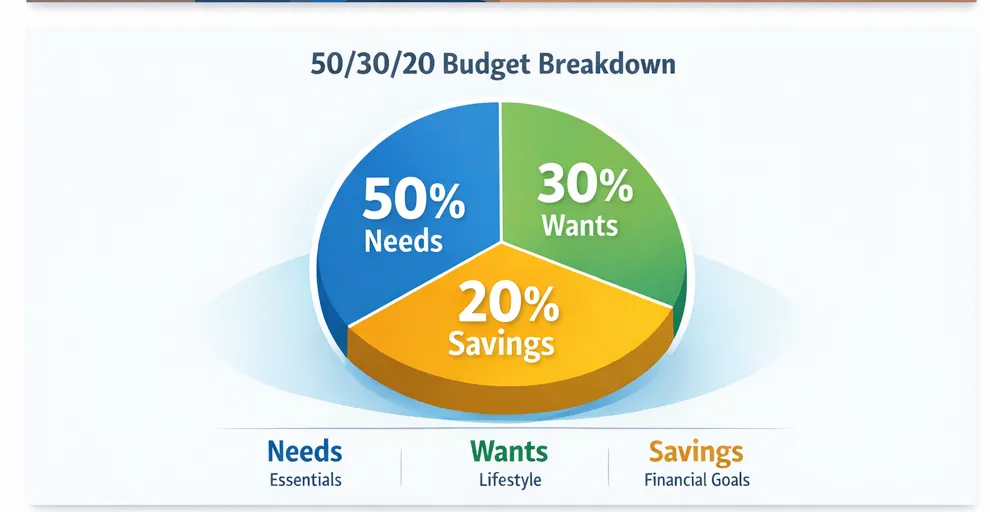
- 50% for Needs – Essential expenses such as rent, utilities, groceries, transportation, insurance, and minimum debt payments.
- 30% for Wants – Lifestyle choices like dining out, entertainment, subscriptions, travel, and hobbies.
- 20% for Savings – Building financial security through emergency funds, investments, retirement contributions, or extra debt repayments.
That’s the entire structure.
There are no complicated spreadsheets with endless expense categories.
No exhausting daily tracking.
No financial expertise required.
Just three straightforward “buckets” that create clarity, balance, and control over your money.
Now, let’s take a closer look at how each category works in practice.
1. 50% for Needs: Cover Your Essentials
This category covers your essential expenses — the non-negotiables that keep your life stable and functioning.
If your fixed expenses feel too high, learn how to reduce monthly expenses without sacrificing essentials.
These are the costs that protect your basic security and quality of life, including:
- Rent or mortgage
- Utilities (electricity, water, internet)
- Groceries
- Transportation
- Insurance
- Minimum debt payments
If these bills go unpaid, the consequences are serious — housing instability, service disconnections, damaged credit, or mounting penalties.
Setting a 50% guideline for needs creates powerful financial awareness. If you discover that your essentials consume 70–80% of your income, that isn’t a personal failure — it’s valuable insight. That clarity helps you make informed decisions: either reduce certain expenses or find ways to increase your income.
Awareness is the first step toward control, and this structure makes that awareness immediate and actionable.
2. 30% for Wants: Enjoy Life Without Guilt
This is where the 50/30/20 rule becomes psychologically powerful.
Many beginner budgets fail because they remove enjoyment completely. But that’s not discipline — it’s deprivation. And deprivation often leads to impulsive “rebound” spending that derails progress.
The 30% category intentionally makes room for lifestyle choices such as:
- Dining out
- Streaming services
- Shopping
- Hobbies
- Gym memberships
- Travel
By deliberately allocating money for enjoyment, the system removes guilt from spending.
You’re not “breaking” your budget.
You’re following it.
That subtle mental shift makes a significant difference. Instead of feeling restricted, you feel balanced. And when a budget feels balanced, consistency becomes much easier to maintain — which is what ultimately drives long-term financial success.
3. 20% for Savings: Build Your Financial Future
This category is the true game changer.
The 20% portion is dedicated to building your financial future, including:
- Emergency funds
- Retirement contributions
- Investments
- Extra debt repayment
Not sure where to start? Our guide on how to build an emergency fund from scratch breaks it down step by step.
Rather than saving whatever happens to be “left over” at the end of the month, this method treats saving as a priority — just like rent or utilities. It becomes a fixed commitment, not an afterthought.
That simple shift changes everything.
Saving moves from optional to automatic. And when saving becomes automatic, progress no longer depends on willpower or mood. Over time, consistency compounds — and that steady discipline builds wealth far more reliably than bursts of motivation ever could.
If you don’t yet have a simple tracking system, follow our complete beginner budgeting guide to see where your money is leaking and how to plug those holes.
Why the 50/30/20 Rule Wins for Beginners
1. It Reduces Decision Fatigue
Traditional budgeting often demands constant micro-decisions:
- “How much should I allocate for groceries?”
- “Are my subscriptions getting out of hand?”
- “Did I overspend in my entertainment subcategory?”
Over time, this level of detail becomes mentally exhausting. The more decisions you have to make, the easier it is to feel overwhelmed — and eventually give up.
The 50/30/20 rule removes that complexity. Instead of juggling dozens of categories, you ask one simple question:
Does this expense fall under Needs, Wants, or Savings?
That clarity reduces decision fatigue. And when budgeting feels simpler and less stressful, you’re far more likely to stick with it. Consistency — not perfection — is what drives real financial progress.
2. It Balances Discipline and Flexibility
Some budgeting systems are overly rigid. Others are so loose that they provide little real guidance.
The 50/30/20 method strikes a healthy balance between the two.
It offers enough structure to prevent financial chaos, yet enough flexibility to adapt to real life. You’re guided by clear percentages, but you’re not trapped by dozens of restrictive rules.
If your income increases, the percentages scale automatically — meaning your savings grow along with your earnings.
If your expenses shift, you can adjust within each category without rebuilding your entire budget.
In other words, the system is firm but forgiving. It provides direction without pressure — and that balance is what makes it sustainable over time.
3. It Prevents Burnout
When starting out, many beginners fall into one of two extremes:
- They save nothing at all.
- Or they try to save 40–50% immediately — feel overwhelmed — and quit within weeks.
Both approaches are unsustainable.
The 50/30/20 rule avoids these extremes by creating steady, realistic momentum. Saving 20% is ambitious enough to make meaningful progress, yet balanced enough to maintain alongside everyday living.
It promotes progress without pressure. Growth without burnout.
And in personal finance, consistency will always outperform short bursts of intensity. Small, steady actions repeated over time build far stronger results than aggressive efforts that can’t be maintained.
4. It Works at Almost Any Income Level
If your income is currently limited, consider increasing it with realistic side income ideas for beginners.
Whether someone earns $800 or $8,000 per month, the percentages remain the same — only the amounts change.
That built-in scalability makes the 50/30/20 rule universally practical. It adjusts naturally to different income levels without requiring a completely new system.
Because it’s based on proportions rather than fixed figures, the method works for students, young professionals, families, and high earners alike.
In the end, it’s not income-dependent — it’s behavior-dependent. And strong financial behavior, applied consistently at any income level, is what drives lasting stability and growth.
How It Compares to Other Budgeting Methods
Other budgeting systems aren’t bad — many are detailed and effective. The difference is that they often require more time, stricter tracking, and greater discipline.
For beginners, that level of complexity can feel overwhelming and difficult to sustain. The challenge isn’t that these systems don’t work — it’s that they demand more effort than most people are ready to commit at the start.
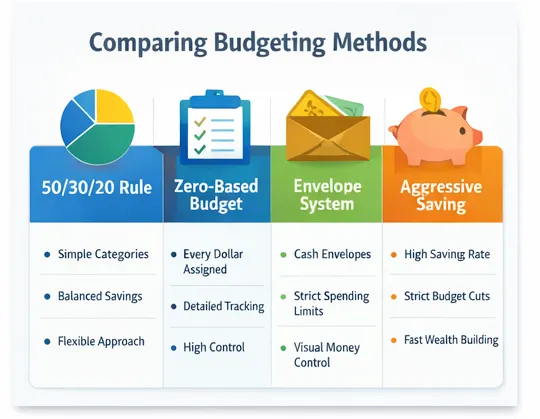
Zero-Based Budgeting
In this approach, every dollar is given a specific role before the month even begins. Nothing is left unassigned — each amount is intentionally directed toward a defined purpose.
The method is highly detailed and can be extremely effective for maintaining tight financial control. However, for beginners, the level of planning and ongoing tracking required can feel time-consuming and mentally demanding.
While powerful, it often requires more structure and commitment than someone just starting out may be ready to manage.
Envelope System
This method uses physical cash envelopes for different spending categories. Each envelope holds a fixed amount, and once the cash is gone, spending in that category stops.
It can be especially powerful for people who struggle with overspending, as physically seeing and handling cash creates strong spending awareness and discipline.
However, in today’s digital-payment world — where most transactions happen through cards, transfers, and online platforms — maintaining a strictly cash-based system can be inconvenient and harder to manage consistently.
Aggressive Savings Models
This approach is designed to accelerate wealth building as quickly as possible. It often encourages aggressive saving and strict spending limits, which can be highly motivating for those ready to move fast.
However, at the beginner stage, such intensity can feel unrealistic and difficult to sustain. When expectations are too high too soon, frustration can replace motivation.
For most people starting their financial journey, simplicity is more powerful than perfection. A system that is easy to follow and maintain will always outperform one that looks impressive but proves exhausting over time.
If you’re starting from zero, read our step-by-step emergency fund guide to build financial security faster.
Budgeting Methods Comparison Table
| Method | Complexity | Best For | Beginner Friendly? |
|---|---|---|---|
| 50/30/20 Rule | Low | Balanced financial growth | Yes |
| Zero-Based Budgeting | High | Detailed expense control | Moderate |
| Envelope System | Medium | Overspending control | Yes (Cash users) |
For those who prefer more precision and control, zero-based budgeting assigns every dollar a specific purpose.
High monthly bills often lead to debt. If that’s your situation, visit our how to reduce debt and stop high interest payments eating your income.
What If You Can’t Reach 20% Savings Yet?
That’s completely normal.
If your current breakdown looks like:
- 60% Needs
- 30% Wants
- 10% Savings
you’re not failing — you’re building awareness and discipline.
Financial progress rarely begins with perfect numbers. It begins with understanding where you stand. From there, you can make gradual adjustments as your income increases or your expenses decrease.
Start where you are. Improve step by step.
The objective isn’t instant perfection. It’s steady, sustainable improvement that compounds over time.
If your income is tight, learn realistic ways to increase your income so you can improve your savings rate.A Simple Example
Let’s assume your monthly take-home income is $1,000.
Using the 50/30/20 framework, it would be allocated as follows:
- $500 → Needs
- $300 → Wants
- $200 → Savings
Rather than monitoring 15 or 20 separate spending categories, your focus is simply to ensure each major bucket stays within its limit.
This approach provides clear financial boundaries without overwhelming detail. You maintain structure and direction — but without the pressure of constant micro-tracking.
It’s disciplined, yet manageable. Structured, but not suffocating.
Who Might Need a Different System?
The 50/30/20 rule isn’t perfect for every situation.
It may be less suitable if:
- Your income fluctuates significantly from month to month
- Your essential expenses already consume 70% or more of your income
- You’re carrying high-interest debt that requires an aggressive repayment plan
In these cases, a more customized or temporary strategy may be necessary to stabilize your finances first.
However, for the average beginner seeking clarity, structure, and better control over their money, this method provides a strong and practical starting point. It simplifies decision-making, encourages balanced progress, and builds foundational financial habits that can be refined over time.
Why This Method Builds Long-Term Financial Discipline
Budgeting isn’t about restriction — it’s about awareness. It’s about knowing where your money goes and making intentional choices that align with your priorities.
The 50/30/20 rule is effective because it focuses on what truly matters. It:
- Simplifies everyday money decisions
- Encourages saving as a built-in habit
- Allows room for enjoyment without guilt
- Builds financial confidence step by step
Beginners don’t need complicated spreadsheets or rigid rules. They need a system that feels manageable and sustainable.
Because real progress doesn’t come from short bursts of discipline — it comes from momentum. And momentum is built through a method you can consistently follow beyond the first 30 days.
Learn More on SmartMoneyTrek
Explore our core financial guides:
- Save Money – proven ways to cut bills and build savings
- Budgeting – Tools and strategies to control your money
- Make Money – real side hustles and income ideas
- Loans & Debt – How to borrow wisely and eliminate debt
Is the 50/30/20 Rule the Best Budgeting Method for You?
If you're new to personal finance, this percentage-based budgeting strategy provides structure without complexity. It teaches balance, builds savings automatically, and prevents burnout.
For most beginners, it is the best budgeting method to start with — because it prioritizes sustainability over perfection.
Frequently Asked Questions
Yes. It is simple, flexible, and easy to maintain without complex tracking.
This is common. Focus on gradual adjustments and increasing income where possible.
Yes. The 50/30/20 rule is a guideline, not a strict law.
Final Thoughts: Best Budgeting Method Should Be Easy to Understand
The best budgeting method for beginners isn’t the most detailed or sophisticated.
It’s the one you can understand today — and still be confidently using six months from now.
The 50/30/20 rule delivers that balance. It provides:
- Structure without rigidity
- Discipline without burnout
- Simplicity without confusion
It gives you a clear starting point without overwhelming you with complexity.
Start here.
Build the habit.
Refine as you grow.
Ready to Apply This Budgeting Method?
Learn how to create a simple monthly budget step by step and start organizing your income today. Create Your Monthly Budget
Your financial journey doesn’t need to begin with perfection. It simply needs to begin with consistency — because consistent action, over time, is what turns small steps into lasting progress.
This content is for educational purposes only and does not constitute financial advice.